October, 2026
Corporate
Blog
Coffee Van for Melbourne Warehouses: How Long to Book?
How Many Coffees and How Long Should You Book?
A warehouse team has 20 minutes for a break, but the coffee queue is still moving when staff need to get back on the floor. It's a small scheduling problem that can quickly turn a thoughtful staff perk into an unnecessary delay. If you're organising a coffee van for warehouse Melbourne staff, knowing how many coffees to plan for and how long to book the service matters just as much as the coffee itself.
As a practical starting point, allow around one drink per participating staff member, with extra capacity for second orders and longer sessions. A single experienced barista may prepare approximately 40–60 coffees per hour, depending on the equipment, menu and ordering pattern.
However, warehouse shift changes can create much busier periods. This guide explains how to estimate coffee numbers, choose suitable service hours and organise mobile coffee catering around your Melbourne warehouse schedule.
How Many Coffees Should You Plan for Warehouse Staff?
The number of coffees required depends on how many employees are working, how many will use the service and whether staff can return for another drink. For a short warehouse coffee visit, planning around one drink per person is a useful starting assumption. For longer sessions, allow additional drinks based on your team's preferences.
Calculate Coffee Numbers Based on Staff Attendance
Start with the number of employees who will actually be on-site during the coffee service, rather than your total workforce.
For example, a Melbourne warehouse with 120 employees might have only 80 staff rostered during the morning shift. Planning coffee for all 120 could overestimate demand, while overlooking contractors, drivers or visiting staff could leave your numbers short.
Consider these factors:
Staff on-site: Count employees rostered during the service window.
Expected participation: Consider whether everyone will want a hot drink.
Repeat orders: Allow extra drinks if staff can return during a longer session.
Additional attendees: Include supervisors, administration staff and other invited workers.
The aim is to estimate the number of drinks likely to be ordered, not simply match the warehouse headcount.
Coffee Quantity Examples for Different Warehouse Sizes
The following figures are illustrative planning allowances, assuming one drink per employee plus a modest buffer. They are not measured consumption rates or guaranteed catering quantities.
Staff attending | Suggested drink allowance |
30 employees | 30–40 drinks |
60 employees | 60–75 drinks |
100 employees | 100–125 drinks |
150 employees | 150–190 drinks |
200 employees | 200–250 drinks |
For shorter morning visits, the lower end may be sufficient. If service runs across several breaks or employees are welcome to order twice, the higher allowance provides more flexibility.
Remember that not every employee drinks coffee. Tea, chai and hot chocolate may also need to be included in the total beverage count.
How Many Coffees Can a Mobile Coffee Van Serve Per Hour?
A single experienced barista working with suitable commercial equipment can generally prepare around 40–60 coffees per hour during a mixed café-style service. An efficient setup with a straightforward menu may achieve higher output. These are planning estimates, not guaranteed service rates, and your provider should confirm capacity before booking.

Why Coffee Preparation Speed Varies
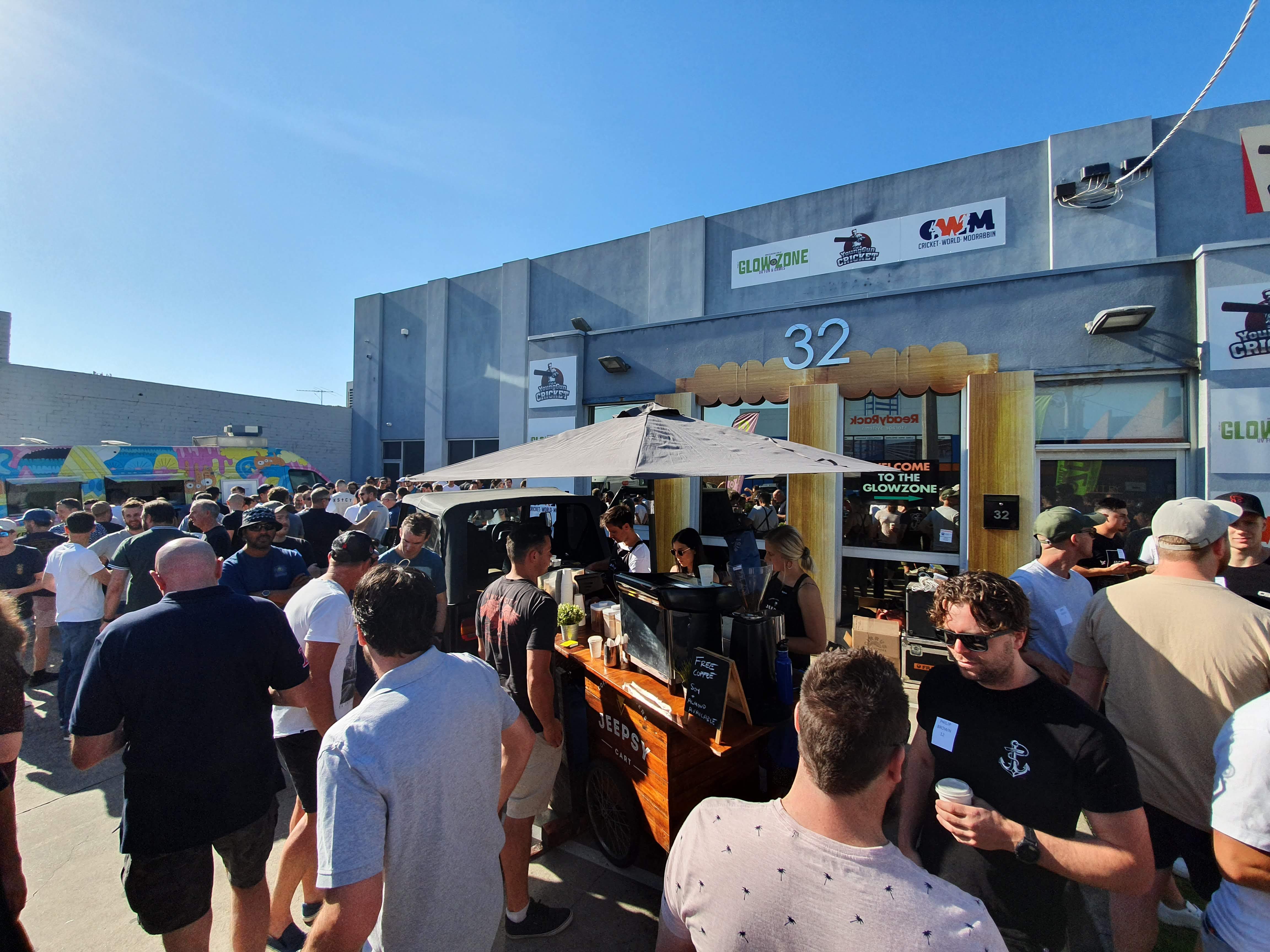
Warehouse coffee catering can be more demanding than a steady stream of customers at a café.
If 60 employees arrive together at 9:30 am, the barista needs to handle many orders within a limited period. A different warehouse with the same headcount but staggered breaks may be easier to serve.
Factors affecting coffee output include:
Drink selection: Flat whites, lattes and cappuccinos require milk preparation, while long blacks generally involve fewer steps.
Equipment capacity: Machine size, grinder performance and available steaming capacity affect output.
Number of baristas: Additional staff can help manage orders, prepare drinks and organise collection.
Order timing: A sudden rush creates more pressure than orders spread throughout the hour.
For more detail, see our guide on how many coffees one barista can make per hour.
Why Peak Demand Matters More Than Total Coffee Numbers
Suppose a warehouse in Truganina plans to serve 100 drinks during a two-hour morning session.
That works out to an average of 50 drinks per hour, which may be manageable for an appropriately equipped single-barista setup.
But what happens if 70 of those drinks are requested during the first 30 minutes?
That creates demand equivalent to 140 drinks per hour during the busiest period. Even though the total order quantity hasn't changed, the service requirements are very different.
This is why the busiest break period should guide your booking, rather than relying on total staff numbers alone.
How Long Should You Book a Coffee Van for Warehouse Staff in Melbourne?
For a smaller warehouse team with one organised break, a 60–90-minute service window may be worth considering. For larger teams or staggered shifts, approximately two to three hours may be more suitable. Warehouses operating multiple shifts may require separate sessions or a longer booking. The final duration should be based on expected drinks and confirmed service capacity.
Short Coffee Visits for Smaller Teams
A shorter session can work well when staff numbers are modest and breaks can be organised without everyone joining the queue simultaneously.
For example, a warehouse in Derrimut with 40 employees on the morning shift might plan a 60–90-minute coffee service, subject to the provider's capacity.
This could suit:
Morning team appreciation activities
Workplace milestone celebrations
Small warehouse staff gatherings
Scheduled coffee breaks before a busy shift
The important consideration is whether employees have enough time to collect their drinks without affecting scheduled work.
Longer Services for Larger Warehouse Teams
For a site with 100–200 staff, booking more service time may help distribute demand.
However, a longer booking doesn't automatically solve queue problems. If everyone gets the same 20-minute break, the coffee station could still become overloaded.
Before choosing a two- or three-hour booking, check how many employees can realistically reach the coffee station during each break.
Melbourne businesses comparing service durations and staffing options can explore mobile coffee cart packages to understand how a booking may be tailored to the workplace.
Why Warehouse Shift Times Make Coffee Catering Different
Warehouse employees rarely have the same flexibility as office staff when it comes to leaving their workstations. Picking, packing, dispatch, stock movements and loading schedules can affect when staff are available.
A successful coffee service needs to work around these operational requirements rather than interrupt them.
Plan Around Morning, Afternoon and Night Shifts
Consider a distribution centre in Dandenong South with morning and afternoon teams.
If the morning shift finishes as the afternoon shift starts, scheduling coffee at the changeover might sound convenient. In practice, employees could be signing out, attending briefings or preparing equipment at exactly that time.
A better approach may involve clearly defined serving periods for each team.
Before confirming your booking, identify:
When each shift starts and finishes
Whether teams have fixed or staggered breaks
How many employees are expected during each break
Whether separate service windows are needed
For workplaces operating overnight, availability for early-morning or late-night catering should be confirmed directly with the provider.
Avoid Having Everyone Queue at Once
Imagine 90 employees receiving a 30-minute break. If all 90 expect coffee during that period, one barista may not be able to complete every order before staff return to work.
If warehouse operations allow, staggered breaks can reduce the pressure.
For example, dividing staff into three groups of 30 gives each group an opportunity to approach the coffee station without joining one large queue.
This arrangement must still be checked against the actual service rate. A group of 30 ordering within 15 minutes requires significantly more hourly capacity than the same group ordering across an hour.
Where Should a Coffee Van or Cart Be Set Up at a Warehouse?
The best coffee station location is a safe, accessible area where employees can order and collect drinks without interfering with warehouse operations. An outdoor staff area, suitable break space or designated section near an employee entrance may work, provided there is enough room for equipment, queues and access.
Keep Coffee Queues Away From Warehouse Traffic
Warehouse locations often have practical constraints that don't apply to ordinary event venues.
A coffee van parked beside a busy loading dock might be convenient for deliveries but unsuitable for staff queuing. Likewise, placing a coffee cart beside a narrow doorway could interfere with pedestrian movement.
Before choosing a location, check:
Pedestrian access: Staff need a clear, designated route to the coffee station.
Vehicle movement: Queues should stay separated from forklifts, trucks and loading activities.
Power access: Confirm the electrical requirements with the coffee provider.
Weather protection: Plan for Melbourne's changing conditions if service will take place outdoors.
A site walkthrough or clear photographs can help the catering team assess whether the proposed position is practical.
Coffee Van or Mobile Coffee Cart: Which Is Better?
A coffee van may suit a warehouse with appropriate outdoor vehicle access and a designated parking location.
A mobile coffee cart may be a better option when staff are gathering in an indoor break area, reception space or covered section that cannot accommodate a vehicle.
The right choice depends on access, safety, equipment requirements and the available service area.
For businesses considering corporate coffee cart hire in Melbourne, it's worth discussing the warehouse layout before confirming the arrangement.
How Can You Keep Coffee Queues Short During Staff Breaks?
Reducing coffee queues starts with matching the number of drinks required to the time available. If staff have short, fixed breaks, ask the coffee provider whether additional baristas, more equipment or staggered ordering would improve service.
Simply extending the booking may not help when most orders arrive together.
Match Barista Numbers to Peak Orders
For a small team with flexible breaks, one barista may be suitable.
For a larger warehouse where numerous staff want drinks at the same time, additional barista support may help manage the rush.
Before requesting a second barista, however, confirm whether the equipment can support the extra workload. Two people sharing a machine don't necessarily produce twice as many coffees.
Keep the Coffee Menu Practical
Melbourne staff will often have their usual coffee orders, whether that's a flat white, cappuccino, latte or long black.
Offering familiar café favourites alongside a few alternatives can keep service practical without unnecessarily limiting choice.
Consider:
A clear menu displayed before employees join the queue
Dairy and non-dairy milk options based on staff preferences
Tea, chai and hot chocolate for non-coffee drinkers
A straightforward ordering and collection process
A well-organised menu allows employees to make decisions before reaching the barista, rather than spending valuable break time choosing at the counter.
What Should You Confirm Before Booking Warehouse Coffee Catering?
A coffee booking for warehouse staff should include more than the event date and headcount. The provider also needs to know when employees will order, how much space is available and whether there are any site access restrictions.
Sharing these details early makes it easier to recommend a realistic service arrangement.
Warehouse Coffee Booking Checklist
Before requesting a quote, prepare the following information:
Workplace details: Warehouse suburb, address and proposed serving location.
Staff numbers: Estimated attendance for each shift or break.
Service timing: Preferred start time, finish time and busiest coffee period.
Site logistics: Vehicle access, unloading arrangements, power availability and indoor or outdoor placement.
For example, a warehouse manager in Laverton North could explain that 120 employees are rostered across two morning break periods, with approximately 60 employees attending each.
That information is much more useful than simply requesting coffee catering for 120 people.
Does Setup and Pack-Down Time Count?
You should confirm whether quoted service hours refer to the time coffee is available or the total time the provider is on-site.
A booking advertised as two hours of service should be clarified before assuming it also includes setup and pack-down within that period.
For a warehouse with scheduled breaks, the distinction matters. If coffee is meant to begin at 7:00 am, the station should be ready to serve at that time, not just arriving at the site.
It is also worth confirming equipment access, power arrangements and who the baristas should contact on arrival.
A Practical Coffee Solution for Melbourne Warehouse Teams
Whether you're arranging a morning shout for a 40-person team in Campbellfield or planning staff appreciation across multiple shifts in Melbourne's west, the same approach applies: estimate drinks, identify peak break times and book enough service capacity to match.
Jeepsy Mobile Baristas provides mobile coffee cart catering for Melbourne workplaces and corporate functions. With professional baristas, espresso coffee and non-coffee options, a planned service can bring the café experience directly to a suitable area of your workplace.
The right booking will depend on your staff numbers, shift timetable, site access and how quickly drinks need to be served.
Planning a coffee shout for your warehouse crew? Get in touch with Jeepsy Mobile Baristas and share your warehouse location, staff numbers and break times. We can help you discuss a suitable coffee setup, service duration and booking options for your Melbourne team.